Retirement
Know Someone Currently Deployed in the Middle East? Here's a TSP Move That Could Save Them Thousands
Zach Rodriguez|June 19, 2026|Read time: 10-12 minutes

With tens of thousands of troops deployed amid the 2026 conflict with Iran, tax-free combat pay opens a narrow window, closing December 31, 2026, to convert TSP savings to Roth at little to no cost. And it isn't only for the deployed: any veteran or service member having a low-income year, after separation, in school, or starting a business, may have the same opportunity.
All dollar figures below are illustrative and stated in today's dollars at an assumed 7% annual return after inflation, in line with the long-run historical average of the U.S. stock market. Your results depend on your income, your state, your rates, and your timeline.
In January 2026, the Thrift Savings Plan (TSP) began allowing participants to convert traditional savings to Roth from inside the account. In a low-income year, that change can be one of the most valuable tax moves an active-duty service member or veteran makes.
What is an In-Plan Roth Conversion?
A Roth conversion moves money from your traditional, pre-tax balance into your Roth, after-tax balance. When you do that, you pay ordinary income tax on the amount you convert in the year of the conversion. In exchange, that money grows tax-free, and qualified withdrawals in retirement come out tax-free.
Until this year, TSP participants could not do this inside the plan. The only path was to separate from service, roll your traditional TSP into a traditional IRA, and convert from there, which left TSP participants with limited options.
That changed on January 28, 2026, when the TSP began allowing Roth in-plan conversions for active participants, including active-duty service members and federal civilians, as well as separated participants, retired participants, and spouse beneficiaries. You can move money to Roth without leaving the plan, rolling anything to an IRA, or separating first.
Why This Is a Bigger Decision Than It Looks
Every dollar in your traditional TSP gets taxed once, and the only question is when, and at what rate. Contributing pre-tax defers the tax until withdrawal. Converting to Roth means paying it now and never owing it again.
The decision comes down to one comparison: is your tax rate today lower than the rate you expect in retirement, considering both federal and state taxes? If so, converting locks in the lower bill now instead of facing a potentially higher tax rate later when you distribute the money in retirement.
The rule change itself was published in the Federal Register, establishing eligibility and limits for Roth in-plan conversions inside the TSP.
The Principle First, Then the Timing
The principle is simple: convert, and pay taxes, when your current rate is below your expected future rate. Veterans have a real edge here because military and post-service life can produce low-income years more often than civilian life does. Whether it is the transition year after separation, a deployment to a combat zone where pay is largely tax-excluded, an early-retirement gap year before a pension or Social Security begins, going back to school full time with the Post-9/11 GI Bill and receiving tax-free Basic Allowance for Housing (BAH), or leaving a job or the military to build a business, each situation can lower taxable income and create a potential opportunity for an in-plan TSP Roth conversion.
Post-9/11 GI Bill housing and benefit rates are set annually on VA.gov. BAH paid under the GI Bill is generally not taxable, which is one reason a full-time school year can open room in lower federal brackets.
Of note, you rarely need to convert everything in a single year, and you usually should not. Spreading conversions across several low-income years, "filling your tax bracket" each year without spilling into the next one, is sometimes called a Roth conversion ladder. We'll touch on it in the examples below.
Why Retirement Taxes Can Be More Than You Think
A military pension is taxable income. Social Security becomes taxable once other income climbs, and required minimum distributions (RMDs) force money out of traditional accounts starting at age 73 whether you need it or not. With many veterans transitioning into a second, well-paid career after military retirement, those streams of income can pile on top of each other in retirement and lead to a higher effective, or average, tax rate than you might expect.
Withdrawing retirement income from a Roth account sidesteps this because qualified withdrawals are tax-free and Roth TSP balances are not subject to required minimum distributions for the account owner. They also do not count toward modified adjusted gross income (MAGI), while traditional withdrawals do, and a higher MAGI in retirement can trigger Income-Related Monthly Adjustment Amount (IRMAA) surcharges on Medicare Part B and Part D.
Learn how IRMAA works and which income counts toward it on the Connecticut Office of the State Comptroller IRMAA explainer.
Three Ways a $50,000 TSP Roth Conversion Could Play Out
Here are three low-income situations military members and veterans may find themselves in where some amount of an in-plan TSP Roth conversion may make sense. For simplicity, assume $50,000 is converted from traditional to Roth in the 12% tax bracket.
The combat-zone deployed service member. With tens of thousands of troops still deployed across the Middle East amid the 2026 conflict with Iran, pay earned there is largely excluded from federal income tax. A traditional-to-Roth conversion this year could be an opportunity that many service members are not currently thinking about. The window closes December 31, 2026, so if a spouse is reading this while their service member is still overseas, it is worth considering before the year ends.
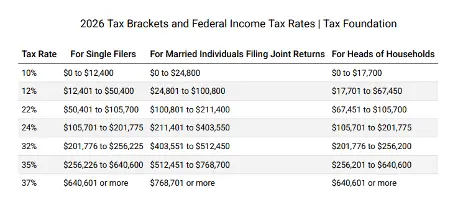
The single MBA student. A recently separated veteran begins a two-year, full-time MBA. With no other taxable income (VA disability and Post-9/11 GI Bill BAH are tax-free), they have the entire 10% and 12% federal income tax brackets to use, which cover taxable income up to $50,400 for single filers in 2026. This veteran has two years to convert up to approximately $100,000 and remain below the top of the 12% federal tax bracket.
The retired veteran starting a business. After military retirement, with 20 or more years of service, a couple decides to start or acquire a business. Filing jointly, their 12% bracket runs to $100,800 of taxable income. During the first couple of years, when business income may be lower, they may have room to convert and stay below the top of the 12% federal tax bracket.
If $50,000 is converted from traditional TSP through an in-plan conversion, assuming 7% annual returns, here is how the math works:
| Convert ($25,000 now, $25,000 next year) | Stay in traditional, hold the tax savings as cash | |
|---|---|---|
| Tax paid now, both years | $6,000, at 12% | $0 |
| Grows to $392,145 | Tax-free | Taxed at withdrawal (18%) |
| Tax owed at withdrawal (18%) | $0 | $70,586 |
| Plus: the $6,000 you didn't spend on tax | Already spent on conversion tax | Sits as $6,000 cash |
| Total at retirement | $392,145 | $327,559 |
| Advantage of converting | $64,586 | |
One caveat: this assumes the $6,000 you would have paid in tax just sits as cash. Invest it instead and the math narrows, since growing it and paying long-term capital gains tax on the growth cuts the advantage to around $30,000, closer to seven months of spending than a full year. Converting still wins in this example, but how much depends on what you would have done with the money you saved.
There is a second reason the school years matter for the MBA student. As a single filer in 2026, the 12% bracket covers taxable income up to $50,400. Convert while single and in school and you fill that bracket cheaply. Marry a working spouse later and your combined income likely lifts you out of the 12% bracket for good, so the rate you can reach now may not come around again.
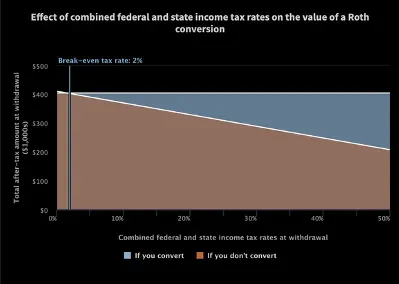
Here is another way to see the same point. Because these examples convert at the 12% rate, the break-even tax rate at withdrawal works out to roughly 2%, according to the TSP's own calculator. That means almost any tax rate you might actually face in retirement, low or high, still favors converting.
Where You Live When You Convert Matters as Much as Timing
If you hold residency in a no-income-tax state, as many service members do while on active duty, and a move to a higher-tax state like California or New York is coming, convert before you go. State tax on a conversion is based on where you live that year, so waiting until after the move could add several thousand dollars to the same conversion.
The reverse holds too. If you live in a high-tax state now and plan to retire to one with no income tax, converting usually works against you, since you would pay your current state's full rate today on money that could have deferred until after you relocated. Contributing to a traditional account and waiting is probably the better move in that case.
One Important Distinction: Converting Is Not the Same as Rolling Over
Everything we've talked about so far happens inside the TSP and is a tax decision about when to pay tax on money you already have. Whether to roll your TSP into an IRA is different; it is a question of where your money lives and how it is invested. The TSP offers rock-bottom fees, the unique G Fund, and strong creditor protection; an IRA offers a wider investment menu and lets you consolidate accounts. Both have merit. You do not have to choose one to do the other, and the good news is that 2026 is the first year when TSP participants can convert inside the TSP without ever rolling a dollar out. I will cover the rollover decision on its own another time.
How to Actually Make the Conversion Inside the TSP
You initiate the conversion through your TSP account online, and the converted amount is added to your taxable income for that year. You cannot withhold taxes from the conversion itself, so you need cash from another source to cover the bill, or you undercut the whole strategy.
The TSP caps in-plan conversions at 26 per calendar year, and you can only convert money held in the core TSP or Lifecycle funds. If you are already taking required minimum distributions, take that distribution first, since a conversion does not satisfy it. Each conversion must be at least $500, and you must leave at least $500 in each traditional fund source afterward. Money sitting in the TSP's mutual fund window is not directly eligible and would need to move back into the core funds first. Unlike a direct Roth IRA contribution, which phases out at higher incomes, there is no income limit here.
If your traditional balance includes tax-exempt combat zone contributions, the math gets more nuanced, so make sure whoever you work with understands military pay. The TSP's own Roth in-plan conversion calculator on tsp.gov can help you model the numbers before you commit. Step-by-step instructions for initiating a conversion are on tsp.gov.
The Traps and the Limits
Pay the tax from outside funds, never from the conversion itself, and remember that the decision is irreversible once made.
Two separate five-year clocks apply to Roth TSP money and confusing them is the most common costly mistake. The first governs whether your Roth earnings come out tax-free, and it starts January 1 of the year of your first Roth TSP contribution, not your conversion; you also need to be 59½ or otherwise qualify. The second, more dangerous one governs penalty-free access to the converted amount itself. Each conversion starts its own five-year clock from January 1 of that conversion year, separate from your retirement timeline. Say you are 56, you convert $30,000 in 2027, and you separate two years later at 58. Because you separated after 55, your other TSP funds become accessible penalty-free right away, but that $30,000 conversion is not available penalty-free until January 1, 2032.
Skip the conversion if you are already in a high bracket with no expected drop in retirement, you lack outside cash to cover the bill, you will need the money within five years, or converting would push you into IRMAA territory. Watch the size of your conversion so it does not spill into a higher bracket and never force one you cannot comfortably afford.
Your Action Plan
- Estimate your marginal (highest) tax rate for this year.
- Estimate your honest expected tax rate in retirement, including pension and Social Security income.
- If your retirement rate looks higher than this year's rate, you're a good candidate to convert.
- Calculate how much room is left in your current bracket and size your conversion to fill it without spilling into the next one.
- Line up outside cash to cover the tax bill before you convert.
Have the conversion modeled before you commit, whether you do it yourself, use the TSP calculator, or work with a qualified tax or financial professional.
The Bottom Line
A low-income year often feels like a step back, though, when used well, it can move your retirement timeline forward. The veterans who understand this are not chasing a complicated strategy but instead using the tax code and the time value of money to their advantage.
Frequently Asked Questions
What is a TSP Roth in-plan conversion?
A TSP Roth in-plan conversion lets you move money from your traditional TSP balance to your Roth TSP balance without leaving the plan or rolling money to an IRA. You pay ordinary income tax on the converted amount in the year you convert, and in exchange that money grows tax-free and comes out tax-free in retirement. The option became available on January 28, 2026, for active-duty service members, federal civilians, separated and retired participants, and spouse beneficiaries.
Who should consider a TSP Roth in-plan conversion?
Veterans and service members in a genuinely low-income year are the best candidates, since converting at a low tax rate now is more valuable than converting at a higher rate later. Common examples include a transition year after separation, a deployment to a combat zone, an early-retirement gap year, full-time school, or the first year or two of starting a business. If your expected tax rate in retirement is higher than your rate this year, the conversion is worth modeling.
Is there a deadline to convert TSP funds in 2026?
Yes. Conversions are tied to the calendar year, not your personal timeline, so using this year's tax bracket or combat zone income requires the conversion to happen by December 31, 2026. This matters especially for service members currently deployed in the Middle East, since the window to use this year's tax-free combat pay closes at year end regardless of when they return.
Wondering if a TSP Roth conversion fits your transition year?
Book a free intro call. We'll look at your brackets, your timeline, and how an in-plan conversion fits your overall financial plan.