OUTLIVE THE ORDINARY
May 2026
Your Time. Your Health. Your Money.
Read time: 6 minutes
By Zach Rodriguez
Welcome to Outlive the Ordinary, a monthly newsletter where I share practical ideas, tools, and reflections to help you take control of your time, your health, and your money.
Allocation, Location, Selection!
In late March, my family welcomed a happy, healthy baby boy into the world! It's been an amazing and eventful month: quality time with each other, frozen meals we prepped a couple months ago, home-cooked meals from friends, and even a little bout of the flu. We haven't made it to the beach as much as we usually do, but I know we'll deeply miss these moments when they're gone.
My wife and I have done this twice before, and our first moments with our third child are still as unique and special as the first times with our other two children. I'm convinced our baby boy will never receive so many kisses again in his life. Our two older children are glued to him, and I've never said, "please stop kissing him" so many times in my life.
It's About Time

Many of you reading this may not be welcoming a newborn baby into the world at the moment. But let the picture above be a reminder to take a spare moment out of your daily grind to notice what's different and how you are grateful for it. The science is clear: gratitude positively rewires the brain, even when we may not get the sleep we hope for.
Which brings me to why I'm writing today. My son's birth is yet another reminder to me of the things worth protecting: our health, our families, and our time. A solid financial plan is really about the same things.
It's About Health
"Among your life's top priorities should be making it into that 6.8-percent of people in the United States who meet the normal criteria for the five basic metabolic biomarkers."
You'll find the above quote in the book Good Energy, by Dr. Casey Means. That's a very specific number, isn't it? She suggests that number because 6.8% of Americans meet normal criteria for five basic metabolic markers without medication. (O'Hearn et al., Journal of the American College of Cardiology (2022)
Shocking stat, right? I recall finding that number unbelievable when I read that it was in the single digits! What surprises me even more is how much we don't talk about this.
Is it just me, or is talking about our health as taboo as talking about money?
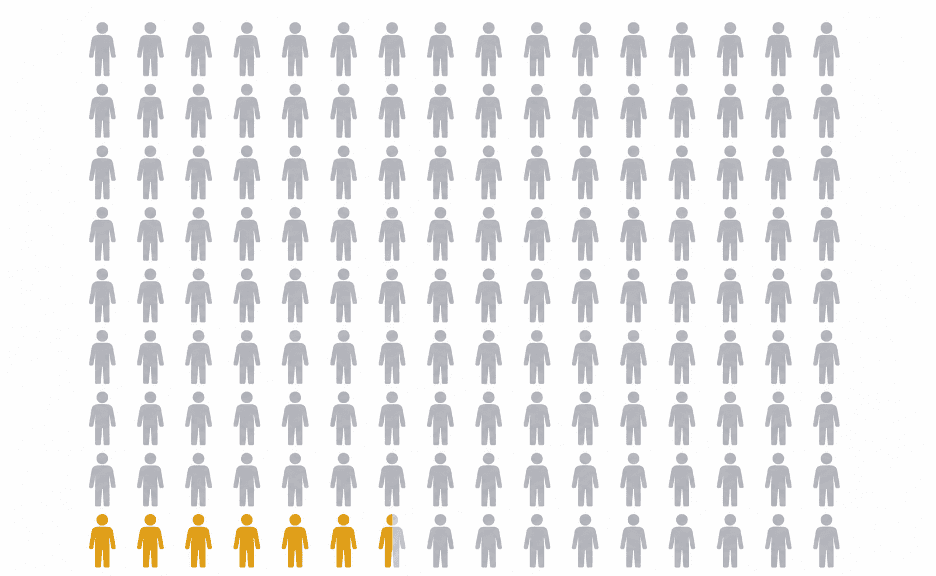
I'd be willing to guess most of us are familiar with our blood pressure and our waist circumference, but we have not committed our #1,2,3 biomarkers to memory. At your next annual physical or blood test, consider paying attention to these five basic metabolic biomarkers. I learned this information from Dr. Means' book and while I have no affiliation, I absolutely recommend reading it (or listening on Spotify). In addition to those five markers, I'm going to share suggested ranges from that book, but keep in mind these are just general guidelines.
1. Triglycerides
- a. Normal Range: <150 mg/dL
- b. Optimal range: <80 mg/dL
2. High-Density Lipoprotein (HDL) Cholesterol
- a. Normal range: >40mg/dL for men and >50mg/dL for women
- b. Optimal range: Sources vary, but likely between 50 to 90 mg/dL
3. Fasting Glucose
- a. Normal range: <100mg/dL
- b. Optimal range: 70-80 mg/dL
4. Blood Pressure
- a. Normal range: <120 systolic (Numerator) and <80 diastolic (Denominator)
- b. Optimal range: Same as normal
5. Waist Circumference
- a. Normal range: <40" for men and <35" for women
- b. Optimal range: Depends on your ethnicity.
To explore the ethnicity-specific ranges or read the full 19-year study mentioned above: O'Hearn et al., JACC (2022)
If you want to know your markers now, then here's what to do. Find your most recent blood test and look at your results. Or, if you're like me, consider scheduling a wide-ranging blood panel to discover even more information. I'm completing a blood test this week that will test 100 different biomarkers, which I will likely share soon!
It's About Money
Everyone is familiar with the saying "location, location, location," usually said when referring to a well-placed corner lot in your favorite part of town. I'm going to introduce a slightly different phrase, and it goes like this: "Allocation, location, selection!"
An "investment" conversation usually starts with, "Have you seen how much [insert favorite company or stock here] has gone up lately?!" It's always exciting to talk about the performance of specific assets and compare them to each other, whether it's an individual stock or a collection of stocks in an index fund.
Similar to monitoring your standard and optimal biomarkers, understanding where to focus your investment strategy matters. But what matters most?
This diagram may help.
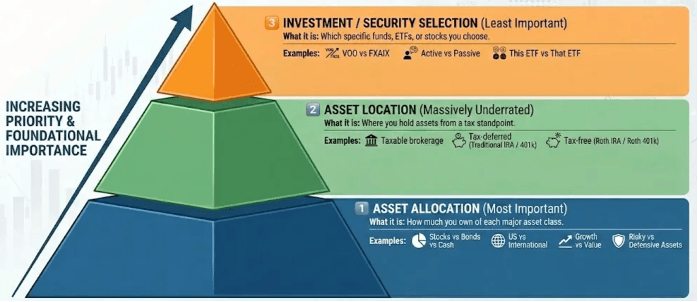
Asset Allocation (the foundation): This is the portion of your portfolio that you own in equities, when compared with bonds, cash, real estate, crypto/digital assets or commodities. For example, a 60% equity / 40% bond portfolio has different performance and volatility characteristics than a 90% equity / 10% bond portfolio, regardless of which specific funds you pick.
Asset Location (the middle layer): Which "tax umbrella" are you under? There are really only three options:
- Tax-free: Pay taxes now, tax-free growth, no taxes when assets are used later. (e.g., Roth IRA / 401k accounts)
- Tax-deferred: Defer taxes now, and pay taxes on growth when you use the assets later (e.g., Traditional IRA / 401k accounts)
- Taxable: When the asset is sold, the profit (capital gain) is taxed at either short-term or long-term capital gains rates, depending on how long the asset was held.
These accounts can each have the same assets inside them and experience the same performance, however the money in your pocket will be different when the asset is sold, in each circumstance.
This is the most underrated part of working with a professional wealth manager. Retail investors don't usually consider diversifying their wealth across tax locations in order to be as effective as possible.
Investment Selection (the top): This is the most exciting layer to talk about; i.e., where you choose to invest. However, as you can see, it's the least important. It's more important to have a great plan with asset allocation and location, before spending too much time on investment selection.
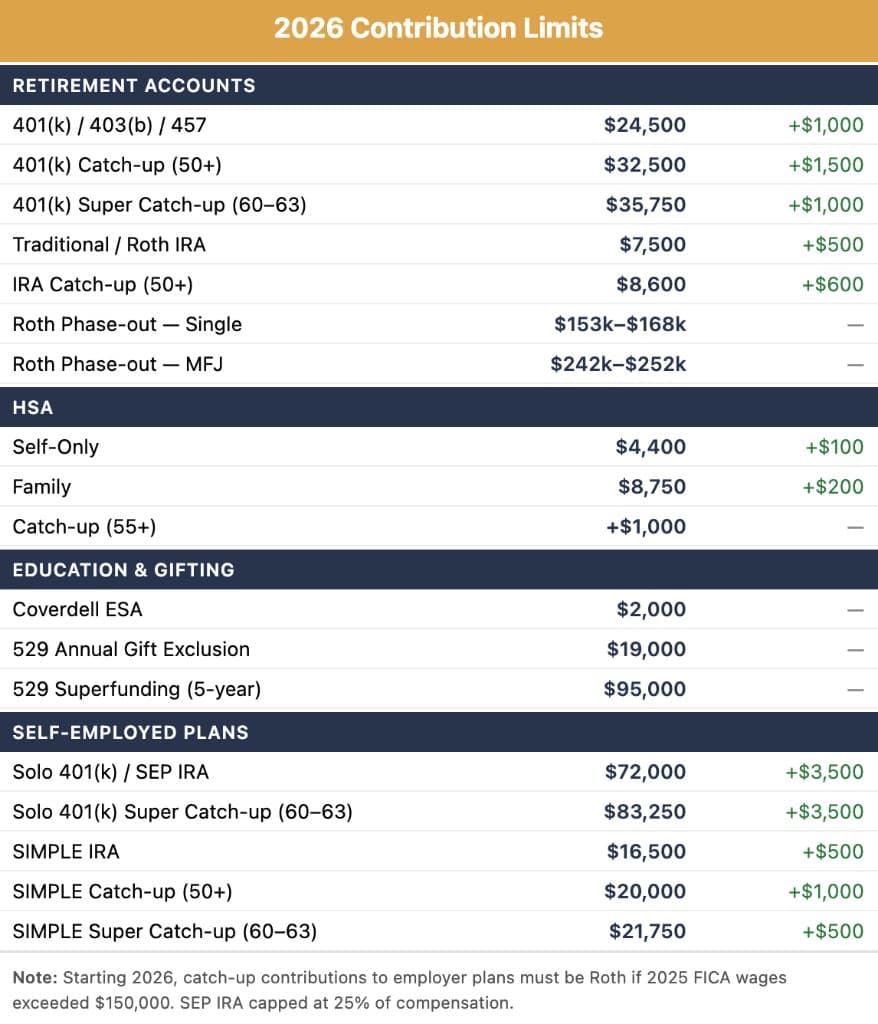
I don't want you to doze off, so I'll stop there for now. Before I sign off, check out this updated chart for 2026 account limits. It's only May and there is still plenty of time to plan and automate investment contributions for the remainder of the year into multiple different types of accounts.
And, remember: Allocation, location, selection!
Until next time,
Zach
When You're Ready, Here Are Three Next Steps
1. Schedule an Introductory call here to see if we may be a good fit to work together.
2. Send me an email at zach@outlivefinancial.com with any questions you may have. I read and respond to each one.
3. Follow along on social media: YouTube, Instagram, LinkedIn, X & TikTok.
Want to share this? If you find the content I share in these newsletters helpful, please feel encouraged to forward it to others; Subscribe to Outlive the Ordinary