OUTLIVE THE ORDINARY
June 2026
Your Time. Your Health. Your Money.
Read time: 5 minutes
By Zach Rodriguez
Welcome to Outlive the Ordinary, a monthly newsletter where I share practical ideas, tools, and reflections to help you take control of your time, your health, and your money.
Tax Planning Strategies
This Month
Three days ago, I separated from active-duty service in the United States Navy. While it doesn't feel like it, I graduated from college 12 years ago last month, and I've already finished with the decade-long commitment I made to the Navy.
Unlike the stories you often hear, I didn't have a noble reason for joining. I raised my right hand and performed the oath of enlistment in 2013. A year earlier I had an internship in college for six months in Austin, Texas, and I was not quite ready to get a picket fence in the Texas suburbs and settle into a 'normal life' after college graduation.
What followed was a 10-year adventure and opportunity to learn about myself, the world, working with others, and of course learning how to fly and then 'fight' the MH-60R Seahawk. As my family now steps into a new chapter, I have feelings ranging from excitement to nostalgia. As with most things in life, I owe more to the Navy for this experience than I expected because I learned so much; much more than just learning to fly.
It's About Time

For the longest time, I felt awkward when people walked up to me and said, 'Thank you for your service.'
As our nation recently celebrated Memorial Day, it was a natural time to reflect on the past decade of my family's life in the Navy. After finishing twelve weeks of Officer Candidate School and going through two years of flight school, so many people would say that five-word phrase to me. Yet, I wasn't sure I understood why they were saying it, or what I had done to 'deserve' their gratitude.
Nowadays, when people say, 'thank you for your service,' many of us think back to the early 2000s after the 9-11 attack and the wars in the Middle East, where thousands paid the ultimate sacrifice.
It is, of course, a loaded phrase. There are so many reasons to appreciate Americans who volunteer for military service. However, after having my three children and deploying on three different ships totaling over a year and a half, I recognize — even if people don't realize it themselves — that they're thanking me and my family for sacrificing our most precious asset: our time.

To be frank, the main reason I gave up flying the mighty MH-60R Seahawk from aircraft carriers and destroyers — which was, admittedly, a badass job — was to start this business and share more of this precious resource, i.e., time with my wife and young children.
To the next generation of service members, I want to thank you for your service. I am grateful for your courage and your sacrifice, even if you don't know you've made it yet.

It's About Health
Have you ever heard people talk about their version of 'health' or heard someone talking about 'being healthy' and rolled your eyes as they discussed the latest fad or subjective interpretation of the word? Certainly there are a variety of ways to be healthy, and I'm not writing this to argue about which is more important. I do, however, want to introduce a concrete way to view your longevity, at least the majority of it.
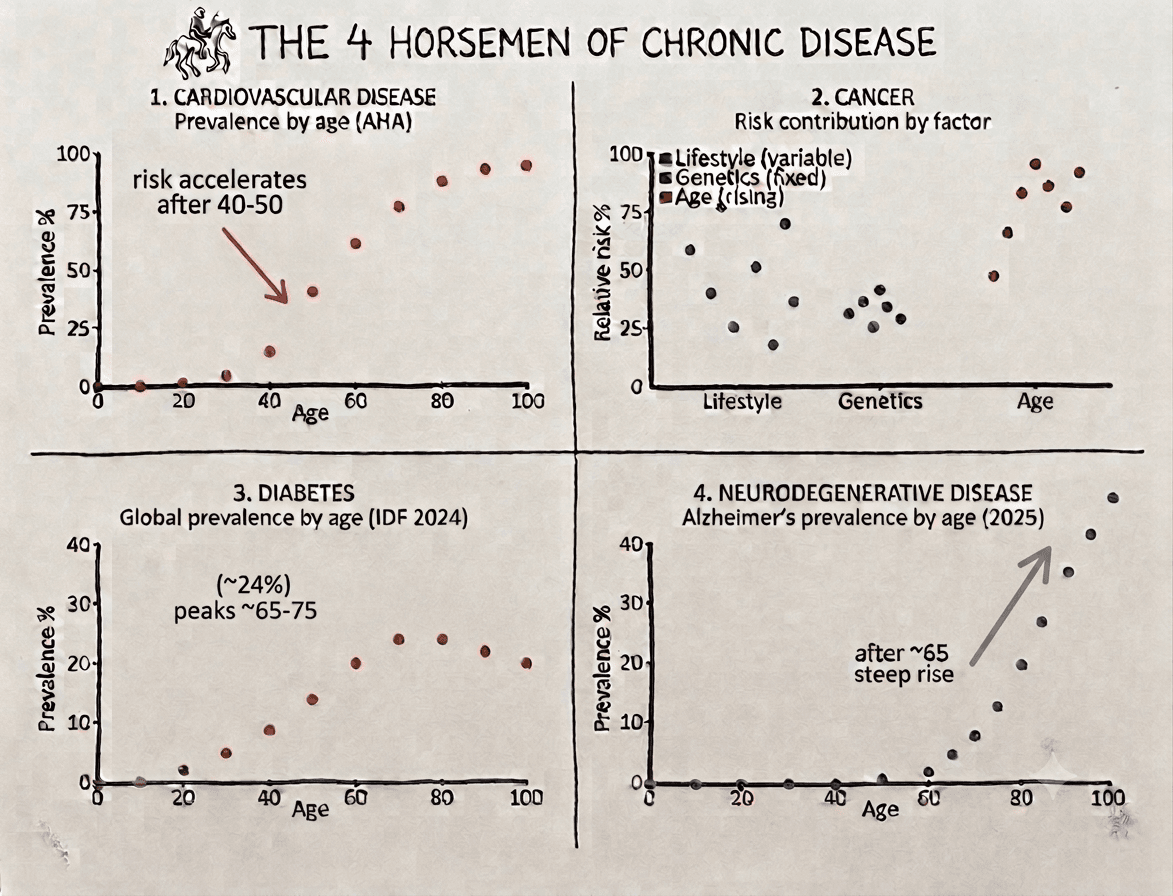
As physician and longevity researcher Peter Attia describes in Outlive, the four conditions below account for over 80% of deaths in individuals over 50 who do not smoke. He calls them the 'Four Horsemen of Chronic Disease.'
1. Atherosclerotic Disease: Includes cardiovascular and cerebrovascular diseases.
2. Cancer: Various forms, including lung, breast, and colorectal cancers.
3. Neurodegenerative Disease: Primarily, Alzheimer's disease.
4. Metabolic Disease: Encompasses conditions like hyperinsulinemia, insulin resistance, fatty liver disease, and type 2 diabetes.
I won't go into detail today, however, learning this deeply changed how I think about health and more importantly the actions I take to 'be healthy.' Looking at the chart below, do you know where you land?
It's About Money
As tax season recently came to a close, it felt like a great time to go deeper on a subject I introduced last month: tax location. Since we're mid-year, it's prime time to do a little tax planning and audit which tax location your money is being invested in 2026.
But first, what does tax planning actually mean?
Most people think about taxes once a year: when they file. That's tax filing.
Tax planning is different. Its purpose is to be strategic with how much income you recognize in each tax bracket, not just this year, but across your entire earning life.
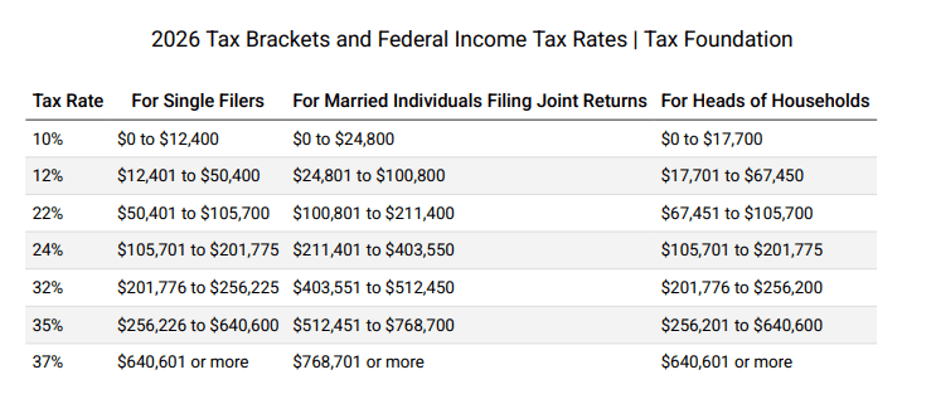
The goal isn't just to minimize taxes this year. It's to optimize your effective tax rate over the next several years (and decades). Meaning, sometimes it makes sense to pay taxes now at a lower rate to avoid paying them later at a higher rate. Other times, the opposite is true. Tax planning can be thought of as a chess game of managing income across brackets over a lifetime, whereas tax filing is just recording the score.
Conventional Tax Planning Examples
- Roth conversions during low-income years: A military officer transitioning to civilian life converts traditional TSP to Roth while income and tax bracket are lower than before and before they're expected to increase again (VA income is not taxable).
- Harvesting capital gains at 0%: If your taxable income is under $49,450 (single) or $98,900 (married) in 2026, you're in the 0% long-term capital gains bracket. Sell appreciated assets and reset your cost basis tax-free.
- Timing RSU vesting or bonuses: Controlling when equity vests or bonuses hit keeps you out of higher brackets and preserves eligibility for deductions and credits.
- Bunching charitable deductions: Give multiple years of donations in one year through a donor-advised fund to clear the standard deduction threshold, then distribute to charities over time.
Recent Changes: One Big Beautiful Bill Act Tax Provisions
- 100% bonus depreciation is permanent: Business owners can write off the full cost of equipment, vehicles, or qualifying real estate improvements in year one.
- 529 contributions increased to $20K: Higher limits, broader uses (apprenticeships, student loans, K-12), and unused funds can roll to Roth IRAs under certain conditions.
- QBI deduction expanded: The 20% deduction for pass-through business income now has broader eligibility and fewer phase-outs. Direct taxable income reduction for business owners.
- $1,000/$2,000 charitable deduction above standard deduction: Even if you don't itemize, you can now deduct up to $1,000 (single) or $2,000 (joint) for direct cash donations to qualified charities starting in 2026.
Depending on your income and situation, these decisions can save you tens or hundreds of thousands of dollars. This is general information and specific decisions should only be made after checking with your tax advisor or financial planner ahead of time. If you want to talk through how any of these rules may apply to your situation in 2026, just reply to this email.
Until next time,
Zach
When You're Ready, Here Are Three Next Steps
1. Schedule an Introductory call here to see if we may be a good fit to work together.
2. Send me an email at zach@outlivefinancial.com with any questions you may have. I read and respond to each one.
3. Follow along on social media: YouTube, Instagram, LinkedIn, X & TikTok.
Want to share this? If you find the content I share in these newsletters helpful, please feel encouraged to forward it to others; Subscribe to Outlive the Ordinary