Health
Healthspan: The First Section of My Clients’ Financial Plans
Zach Rodriguez|November 19, 2026|Read time: 5 min read
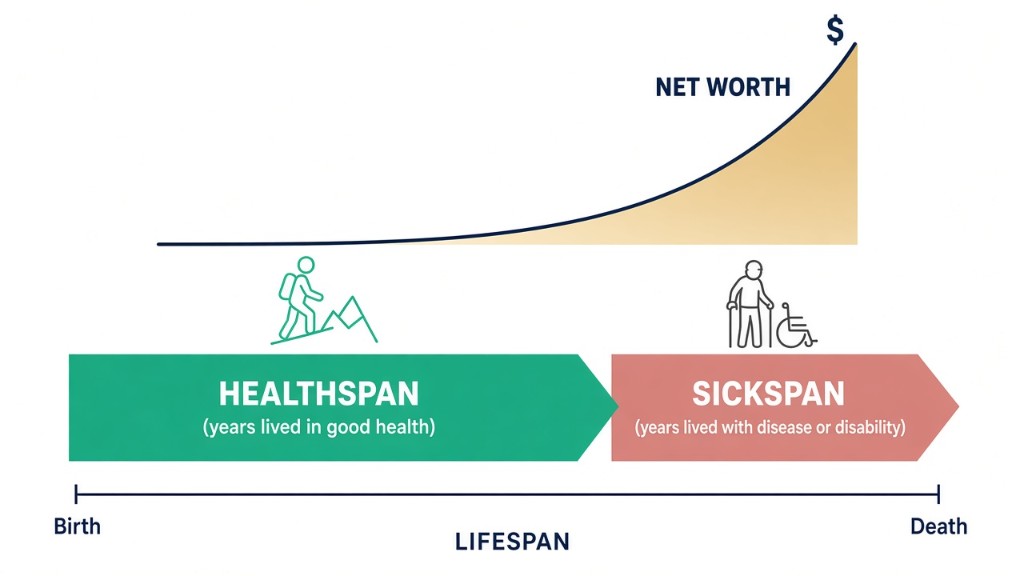
Why my financial plans open with healthspan: how your health shapes retirement costs, long-term care risk, and the years you get to enjoy your money.
What's on Page One of Your Financial Plan?
If you were my client, what do you think would be on page one of your financial plan? Your net worth? A retirement projection? An insurance summary? Nope!
The first five pages of EVERY financial plan I've presented are composed of a section I call "Healthspan Planning: Measuring What Matters," for which I utilized information from two books: "Good Energy" by Dr. Casey Means and "Outlive" by Dr. Peter Attia. The section discusses the four biggest risks to your financial plan and covers biomarkers like blood sugar, cholesterol, and inflammation, as well as fitness markers like VO₂ max and grip strength. One statistic in that section that still surprises me: only 6.8% of U.S. adults had optimal levels of all five of these cardiometabolic health measures:
- Body fat (BMI and waist size)
- Blood sugar (fasting glucose and A1c)
- Cholesterol (total cholesterol to HDL ratio)
- Blood pressure
- No history of heart disease or stroke
So, why do I start a financial planning topic with “Health”? It could seem like it's as off-putting as talking about politics or religion with a client. Well, first, I approach the topic with humility, with a genuine passion for it, and with no interest in getting medical information from my clients.
I share that just like the asset column of your balance sheet (hopefully composed of taxable, tax-free, and pre-tax assets), your health IS an asset AND it directly affects a family's financial independence journey.
Financial planners review a client's 401(k) balance and insurance landscape, but never even think to discuss blood sugar or how much muscle they're carrying into their sixties. More than 2 in 5 American adults have prediabetes, and 8 in 10 of them don't know it, according to the CDC. In a study in The Journal of the Economics of Ageing, people in the top third of health averaged 50% more wealth over 16 years than those in the bottom third. A Harvard study found that adults who kept five healthy habits lived roughly 12 to 14 years longer than those who kept none.
As a financial planner, this is where the numbers get my attention. Fidelity estimates a 65-year-old retiring in 2026 may spend about $185,500 on health care in retirement, not counting long-term care. Yet someone turning 65 has almost a 70% chance of needing some long-term care, and a private nursing home room had a 2025 national median cost of $129,575 a year. A Mayo Clinic study also found Americans live an average of 12.4 years with disability and sickness, otherwise referred to as “sickspan.”
Which means that most financial advisors, sadly, help clients accumulate wealth so they can spend it in the years when they're physically at their worst.
Does that make sense to anyone?
Imagine with me for a moment. What would it look like to shift the allocation of resources slightly? Since we know the four largest chronic killers of people are cardiovascular disease, cancer, neurodegenerative disease, and type 2 diabetes (what Dr. Peter Attia calls the “Four Horsemen” in Outlive), let's walk through a hypothetical example.
Say a 38-year-old is maxing their 401(k) at $24,500 for 2026, has a net worth of $1.8 million, and their plan shows roughly a 90% or better probability of having what they need to be financially independent at their goal of age 56. Financially, that likely puts them in the top 10% for their age.
Let's assume they plug their numbers into the American Heart Association's PREVENT calculator, which estimates 10-year and 30-year risk of cardiovascular disease, which is the leading cause of death in the U.S., and it shows how their 30-year risk compares with people of the same age and sex. In this hypothetical, their 30-year risk comes back higher than about 80 of 100 people their age and sex. Put another way, on paper they're in the top 10% financially and the bottom 20% for heart health.
So what if they contributed a couple thousand dollars less to their 401(k), for example, and utilized the money, or even time (yes, work less), toward lowering that risk: more exercise and daily movement, and quality food to improve their personal health outcomes? At an assumed 6% annual return, $2,000 a year for 20 years could grow to about $73,571, so the trade-off is real. However, lowering that risk early can compound physical health in a positive direction!
And if they don't even know where their risk factors stand to begin with, as their financial advisor, I'd encourage them to start by seeing their doctor through their health insurance, then consider engaging a longevity-minded, proactive healthcare provider and/or spending $365 on a Function Health membership to kickstart their journey.
I Realize I'm Early
Earlier this month, on Veterans Day, Rethinking65 published my article, "Why This Navy Vet Wants Advisors to Rethink Longevity Planning," where I go into more depth on why this is important to me and why I think other financial advisors should be talking about it.
I'm new to this industry, and I know I'm early; however, I'm starting to hear “rumblings” of a human being's health being given the time of day it deserves. On The Perfect RIA, a podcast for financial advisors, in an episode published earlier this month, Matthew Jarvis interviewed Stevyn Guinnip, founder of Grow Wellthy, about treating health as an asset: the difference between lifespan and healthspan, and connecting health to retirement spending and quality-of-life goals. I suspect that in a decade or two it will be obvious to the whole industry and to our clients. Or perhaps it may already be. In Charles Schwab's 2025 Modern Wealth Survey, 37% of Americans said physical health contributes to their personal definition of wealth.
Measuring My Own Numbers
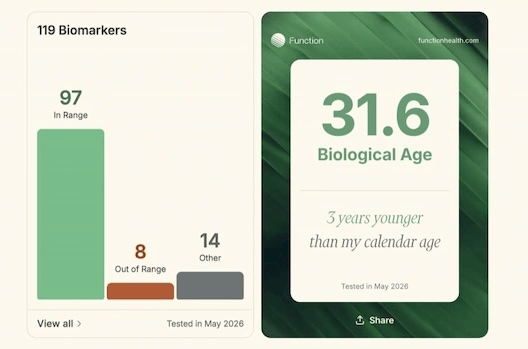
This past spring, I tested more than 100 biomarkers through Function Health, across areas like autoimmunity, blood, electrolytes, environmental toxins, heart, immune regulation, metabolic health, nutrients, and more. While I received 50+ biomarkers annually at my flight physical while I was a Naval Aviator, and always analyzed the blood tests from life insurance medical exams, I was very excited to dive deeper into my current bloodwork to have a baseline to reference and improve upon. I discuss a few lessons learned in the article above and look forward to unpacking more soon in a future post.
Stay Curious
I'll end with the same thing I encouraged financial advisors to do. If this sounds like a good idea, and you don't know where to begin, my advice is to be curious. Watch a documentary, pick up a longevity book, ask ChatGPT how to know your current risk factors and how to be proactive with your health, and bring questions to health providers you know or who help you.
It may just change the way you look at your life, and what is more powerful than that?
After all, the best financial plan is a tragedy if the client isn't there to enjoy it.
Important Disclaimer
Outlive Financial Planning is a registered investment adviser in the State of California. This post is for educational purposes only and is not financial, tax, or medical advice. The example is hypothetical, for illustrative purposes only, and is not a projection or recommendation. Actual returns and health outcomes will vary. Consult your own advisor and healthcare provider before making decisions. I have no affiliation with Function Health and receive no compensation from it. I paid for my own membership, and other labs and doctors offer similar testing.
Frequently Asked Questions
Why does your financial plan start with health?
Because your health is an asset. A financial plan is meant to put you first, so why would it leave out your physical and mental health? Your health shapes how long you can work, what retirement costs, and how many years you get to enjoy your money. That is why the first section of every plan I build covers healthspan.
How much might health care cost in retirement?
Fidelity estimates a single 65-year-old retiring in 2026 may spend about $185,500 on health care in retirement, not counting long-term care. Your own costs could be higher or lower.
How likely is it that I'll need long-term care?
According to the U.S. Administration for Community Living, someone turning 65 today has almost a 70% chance of needing some type of long-term care, and about 20% will need it for more than five years. CareScout's 2025 Cost of Care Survey put the national median cost of a private nursing home room at $129,575 a year.
What's the difference between lifespan and healthspan?
Lifespan is how long you live. Healthspan is how long you live in good health. A 2024 Mayo Clinic study of 183 countries, published in JAMA Network Open, found the U.S. had the largest gap between the two: on average, Americans live about 12.4 years with disability and disease, based on 2019 World Health Organization data. Some people call those years the sickspan.
Do you give medical advice?
No. I'm not a doctor, I don't diagnose anyone or interpret labs, and I don't ask clients for medical information. I encourage clients to bring their questions to their own doctor.
Want a plan that starts with your health and your why?
Book a free intro call. We will talk through what you want from the years ahead and how a financial plan can support that.